
Women and blood clots:
Understanding thrombosis risk throughout life
Understanding thrombosis risk throughout life
Women and blood clots: What you need to know
Women and blood clots share a unique relationship shaped by hormonal changes, pregnancy, and life stages. Understanding how and when blood clots affect women differently than men empowers better healthcare decisions and early recognition of warning signs.
While blood clots can affect anyone, women face specific thrombosis risks throughout their lives related to reproductive health and medications affecting hormone balance. Venous thromboembolism (VTE), which includes deep vein thrombosis (DVT) and also pulmonary embolism (PE), represents the most common serious complication of hormone-related therapies in women.
A woman’s blood clot risk evolves across her lifespan.
During reproductive years, hormonal contraception introduces important VTE risk considerations. Pregnancy and the postpartum period generally bring some of the highest clotting risks women will experience. Later in life, the transition through menopause and decisions about hormone replacement therapy require careful evaluation of thrombosis risk versus quality of life.
The good news
These risks are manageable with proper awareness and medical guidance. Understanding your personal risk factors, recognizing warning signs, such as leg swelling or chest pain and having informed conversations with healthcare providers empowers you to make safer choices and seek timely medical care when needed.

Resources on women’s health and blood clots
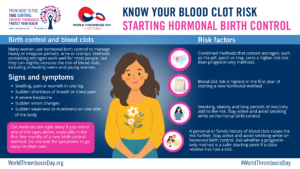
Estrogen-containing birth control and blood clots

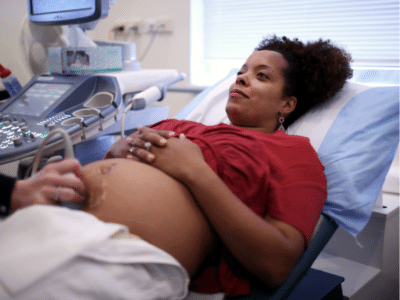
Pregnancy and blood clots
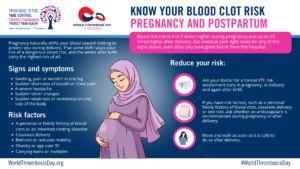
Pregnancy increases the risk of venous thromboembolism (VTE) by about four to five times compared with being non-pregnant.9,10,11 The risk is highest during the first six weeks after delivery, when the risk of VTE may be about 20 times higher than in non-pregnant women.12,13,14
Pregnancy increases clotting risk because of changes that help prevent excessive bleeding during childbirth, including changes that make blood clot more easily, slower blood flow and pressure on veins from the growing uterus.
Blood clots can occur at any point during pregnancy or after delivery. Deep vein thrombosis (DVT) during pregnancy is more likely to occur in the left leg.
Women with a previous blood clot, thrombophilia or other risk factors may need medication to prevent blood clots during pregnancy and after delivery. Low molecular weight heparin (LMWH) is commonly used when anticoagulation is needed during pregnancy.
VTE risk should be assessed during pregnancy and after delivery, particularly at the first prenatal visit, during hospitalization and following childbirth.
Managing perimenopause, menopause and blood clots
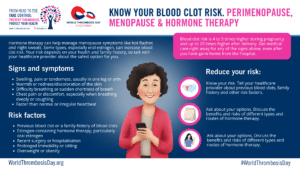
Perimenopause typically begins in a woman’s mid-to-late 40s and can cause symptoms such as hot flashes, night sweats and sleep disturbances.18 For women considering hormone therapy to manage these symptoms, the type of hormone therapy matters. Oral estrogen therapy is associated with an approximately two- to three-fold increase in VTE risk, while transdermal estrogen delivered through patches, gels or sprays appears to have a much lower VTE risk.19–24
Special Considerations for Women at Risk
Women with inherited blood-clotting conditions, such as Factor V Leiden or the prothrombin gene mutation, may have a higher risk of VTE when using hormone therapy. Women with a previous blood clot may still be candidates for menopausal hormone therapy, and transdermal estrogen may be considered in some cases. Treatment decisions should be individualized and made with a healthcare professional.25
Long-Term Cardiovascular Health
**Early menopause, particularly before age 45, is associated with an increased risk of cardiovascular disease and stroke later in life.**26–28 The decline in estrogen during menopause is associated with changes in cardiovascular risk factors, making heart and blood vessel health an important part of women’s health during and after the menopausal transition.
This version preserves the key information you had: when perimenopause occurs, symptoms, oral vs. transdermal therapy, the VTE statistics, thrombophilia, Factor V Leiden, prothrombin mutation, previous VTE, individualized treatment and early menopause/cardiovascular risk, without making the section feel overwhelming.

Clinical insights on VTE prevention in contraception, pregnancy and postpartum.
Understanding thrombosis risk in women requires specialized clinical knowledge, particularly across life stages marked by significant hormonal changes. World Thrombosis Day and International Society on Thrombosis and Haemostasis (ISTH) partnered the Centers for Disease Control and Prevention to host an expert roundtable on women’s health and thrombosis, bringing together leading specialists to examine blood clot risk associated with contraception, pregnancy and the postpartum period. The discussion offers healthcare professionals a clinically grounded resource for navigating venous thromboembolism prevention in female patients.
Downloadable World Thrombosis Day resources:
Women’s health and thrombosis
Women’s health and thrombosis


Support the campaign
Elevate your organization’s visibility in the global healthcare community by becoming a supporter of the World Thrombosis Day campaign. Your partnership supports critical education and advocacy initiatives while connecting your brand with healthcare professionals and patients worldwide. Explore our support opportunities today to make a meaningful impact in thrombosis awareness and prevention.

Share your story
Share your personal blood clot experience with the World Thrombosis Day campaign to help educate and inspire others facing similar challenges. Your story can provide hope, raise awareness about risk factors and potentially save lives. Join our global community of survivors and advocates by submitting your story today
Page references:
1.Hormonal Contraception and Thrombotic Risk: A Multidisciplinary Approach. PMC.
https://pmc.ncbi.nlm.nih.gov/articles/PMC3025417/
2. Estrogen and Thrombosis: a Bench to Bedside Review. PMC.
https://pmc.ncbi.nlm.nih.gov/articles/PMC7341440/
3. Estrogen, progestin, and beyond: thrombotic risk and contraceptive choices. ASH Publications.
https://ashpublications.org/hematology/article/2024/1/644/526191/
4. Hormonal therapies and venous thrombosis: Considerations for prevention and management. PMC.
https://pmc.ncbi.nlm.nih.gov/articles/PMC9399360/
5. Combined hormonal contraception and the risk of venous thromboembolism. ASRM.
https://www.asrm.org/practice-guidance/practice-committee-documents/combined-hormonal-contraception-and-the-risk-of-venous-thromboembolism-a-guideline-2016/
6. Women’s Health – Blood Clots. Stop the Clot.
https://www.stoptheclot.org/learn_more/womens_health_faq/
7. Hormonal Birth Control: Risk of Blood Clots. Kaiser Permanente.
https://healthy.kaiserpermanente.org/health-wellness/health-encyclopedia/he.hormonal-birth-control-risk-of-blood-clots.tw9278
8. The risk of venous thromboembolism in oral contraceptive users. American Journal of Obstetrics and Gynecology.
https://www.ajog.org/article/S0002-9378%252823%252900618-X/fulltext
9. Understanding Your Risk for Blood Clots with Pregnancy. CDC.
https://www.cdc.gov/blood-clots/risk-factors/pregnancy.html
10. Venous Thromboembolism in Pregnancy. Arteriosclerosis, Thrombosis, and Vascular Biology.
https://www.ahajournals.org/doi/10.1161/atvbaha.109.184127
11. Thromboembolism in Pregnancy: Background, Pathophysiology, Etiology. Medscape.
https://emedicine.medscape.com/article/2056380-overview
12. Deep venous thrombosis in pregnancy: incidence, pathogenesis and endovascular management. PMC.
https://pmc.ncbi.nlm.nih.gov/articles/PMC5778511/
13. Management of Postpartum Extensive Venous Thrombosis after Second Pregnancy. PMC.
https://pmc.ncbi.nlm.nih.gov/articles/PMC10221295/
14. Risk of a Thrombotic Event after the 6-Week Postpartum Period. NEJM.
https://www.nejm.org/doi/full/10.1056/NEJMoa1311485
15. Excretion of low molecular weight heparin in human milk. PMC.
https://pmc.ncbi.nlm.nih.gov/articles/PMC2014571/
16. Anticoagulants and Breastfeeding. The Breastfeeding Network.
https://www.breastfeedingnetwork.org.uk/factsheet/anticoagulants/
17. Heparin – Drugs and Lactation Database (LactMed®). NCBI.
https://www.ncbi.nlm.nih.gov/books/NBK500921/
18. Menopause and Stroke: An Epidemiologic Review. PMC.
https://pmc.ncbi.nlm.nih.gov/articles/PMC3615462/
19. Postmenopausal hormone replacement therapy and venous thromboembolism. PubMed.
https://pubmed.ncbi.nlm.nih.gov/16551553/
20. Oral Contraceptives and HRT Risk of Thrombosis. PMC.
https://pmc.ncbi.nlm.nih.gov/articles/PMC6714678/
21. Certain HRT tablets linked to increased heart disease and blood clot risk. BMJ Group.
https://bmjgroup.com/certain-hrt-tablets-linked-to-increased-heart-disease-and-blood-clot-risk/
22. Postmenopausal Estrogen Therapy Route of Administration and Risk of Venous Thromboembolism. ACOG.
https://www.acog.org/clinical/clinical-guidance/committee-opinion/articles/2013/04/postmenopausal-estrogen-therapy-route-of-administration-and-risk-of-venous-thromboembolism
23. Risk of venous thrombosis with oral versus transdermal estrogen therapy among postmenopausal women. PubMed.
https://pubmed.ncbi.nlm.nih.gov/20601871/
24. Menopause and Clots. The Menopause Charity.
https://themenopausecharity.org/information-and-support/living-with-other-conditions/menopause-and-clots/
25. What types of Hormone Replacement Therapy are safe? Professor Andreas Obermair.
https://www.obermair.info/latest-news/blog/hormone-replacement-therapy/
26. Age at Menopause and Risk of Ischemic and Hemorrhagic Stroke. Stroke, AHA.
https://www.ahajournals.org/doi/10.1161/STROKEAHA.120.030558
27. Menopause before 40 tied to higher stroke risk. American Heart Association.
https://www.heart.org/en/news/2021/06/03/menopause-before-40-tied-to-higher-stroke-risk
28. Premature menopause or early menopause and risk of ischemic stroke. PMC.
https://pmc.ncbi.nlm.nih.gov/articles/PMC3258468/1
